


Le Moje between nature, watersprings and local history
An easy and not very demanding walk, ideal also for families, is the route starting from Vilminore, passing by the Oratory of San Carlo, and reaching the “Le Moie” area – Vilminore (circular route).
Starting from the town of Vilminore, you can follow a path along the road leading to Oltrepovo, rich in history and culture, discovering some geological and human traces left over the centuries.
This itinerary is about 2 km long, suitable for everyone, including families with children, offering nature, springs, fountains, and local history. In particular, the points of interest along the route, starting from Vilminore, are:
- VAL DE CRUS CHAPEL
Following the road from Vilminore to Bueggio, just outside the town in the area called Valle di Croce, there is a small building with a sacred image, built in the 1600s by the Albrici family. In this place, on January 28, 1886, an avalanche from Pizzo di Pianezza also descended, striking three young men: Lorenzo Ronchis, 33, Giovanni Lenzi, 26, and Giov. Maria Bettineschi, 21. This tragedy probably gave the name to the small valley, due to the three crosses that commemorate the disaster.
- CHURCH OF SAN CARLO
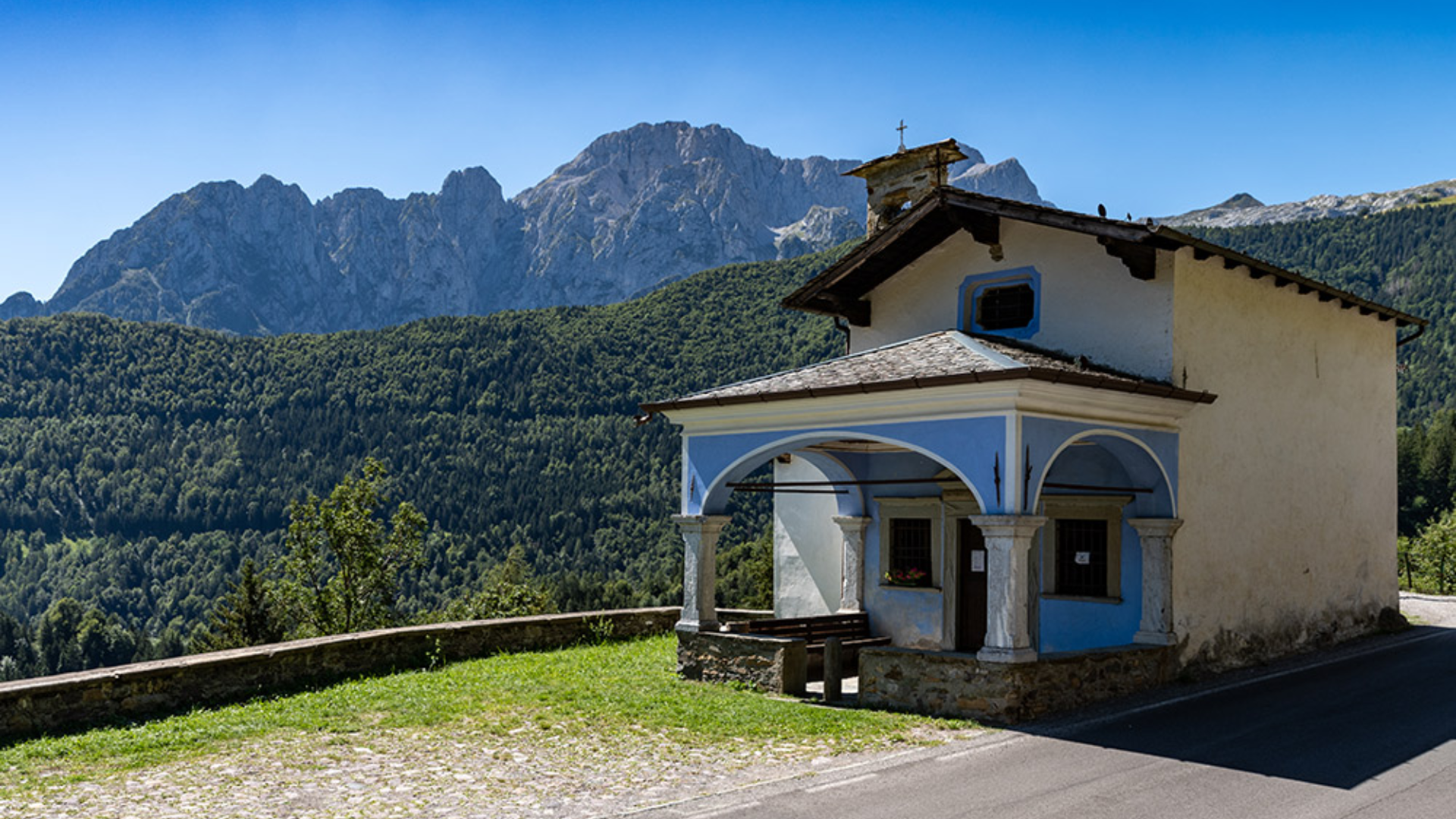
Continuing the route, you will reach the Oratory of San Carlo, a small and very characteristic church, with a frescoed porch painted in a lively sky blue. In the central part, Saint Charles is depicted in glory, surrounded by cherubs holding episcopal symbols. On one of the two side vaults, the corporal work of mercy “feeding the hungry” is represented. On the other vault, a virgin with a Cross and Chalice, symbols of faith, is depicted.
Once you pass the Oratory of San Carlo, you can continue by taking the dirt road immediately after the small church, which descends to the left from the main road, heading towards Moje, Cajane, and Gras.

- SPRINGS, FOUNTAINS, AND IRRIGATION CHANNELS
The areas of Moje and Cajane are particularly rich in water sources and springs, with temperatures reaching 11.2°C. Unfortunately, this water, although bacteriologically pure, is not drinkable because it contains a very high percentage of copper and a strong electrical charge.
The irrigation channels (seriole) were used until the 1970s to water the meadows, especially during dry periods. These channels, unique in Val di Scalve, allowed for greater hay production at each cut. While other valleys typically had two hay cuts per year, here there were three. The channels also transported cow manure directly from the stables to the meadows, mixing it with water first. The total length of these channels was over 1 km in Moje and 700 m in Cajane.

- VIEWPOINT OF THE ULTRA-MILLENNIAL TREE DISCOVERY SITE
This is an exceptional find, unique in the Alps, including France, Switzerland, and Austria, to the extent that their palynology and geology museums requested samples. During the last glaciation, these trunks were buried by moraines created by glaciers at a depth of about 70 meters underground. The first trunk was discovered in the early 1970s but was unfortunately lost. Later, in 2007, two more trunks were found; this time they were recovered and entrusted to the C.N.R. for study. It was determined that they were larches that lived around 48,000 years ago, during the Neanderthal era. Recently, other trunks have been discovered. At the Mountain Community office in Vilminore, a totem was created by the Orobie Park, where it is possible to learn all the interesting details revealed by these studies.

- FRESCO “SUN OF THE ALPS”
Observing the Moje farmhouse, you can see a fresco that, at first glance, may seem like the “Sun of the Alps.” In reality, it tells the story of the Zanoni-Morzenti couple (who lived here from 1943 to 1977). Their family is represented in the fresco: the center of the sun, the pride of the family, is surrounded by six rays, each bearing the name of one of their children. The two images depict the couple. One of the six rays has no name, as a maternity did not succeed. The house next to the stream, four centuries old, was most likely built by Notary Comino Morzenti and, after several ownership changes, was acquired by the Albrici notaries and legal scholars, and later by the Zanoni family.
- THE MORAINE
The important moraine, still present today between the Nembo and Povo streams, was created by glaciers descending from Pizzo di Petto and Mount Gleno and reaches a height of over 100 meters. Moraines form from the slow movement of the glacier, with materials falling from the mountains due to frost, rain, wind, earthquakes, etc. This particular moraine begins at “La Polza,” about half a kilometer beyond Bueggio. From here, you can return to the Moje access intersection, heading back to Vilminore; at the second bridge, do not cross it but continue on the road to the right, and after about 200 meters you arrive in Vilminore, in the Piazzola area.
It is possible to take guided visits along this route by contacting the “Infopoint ARS” tourist office in Vilminore di Scalve for more information.


Route information
- Fino a 500: Fino a 500