

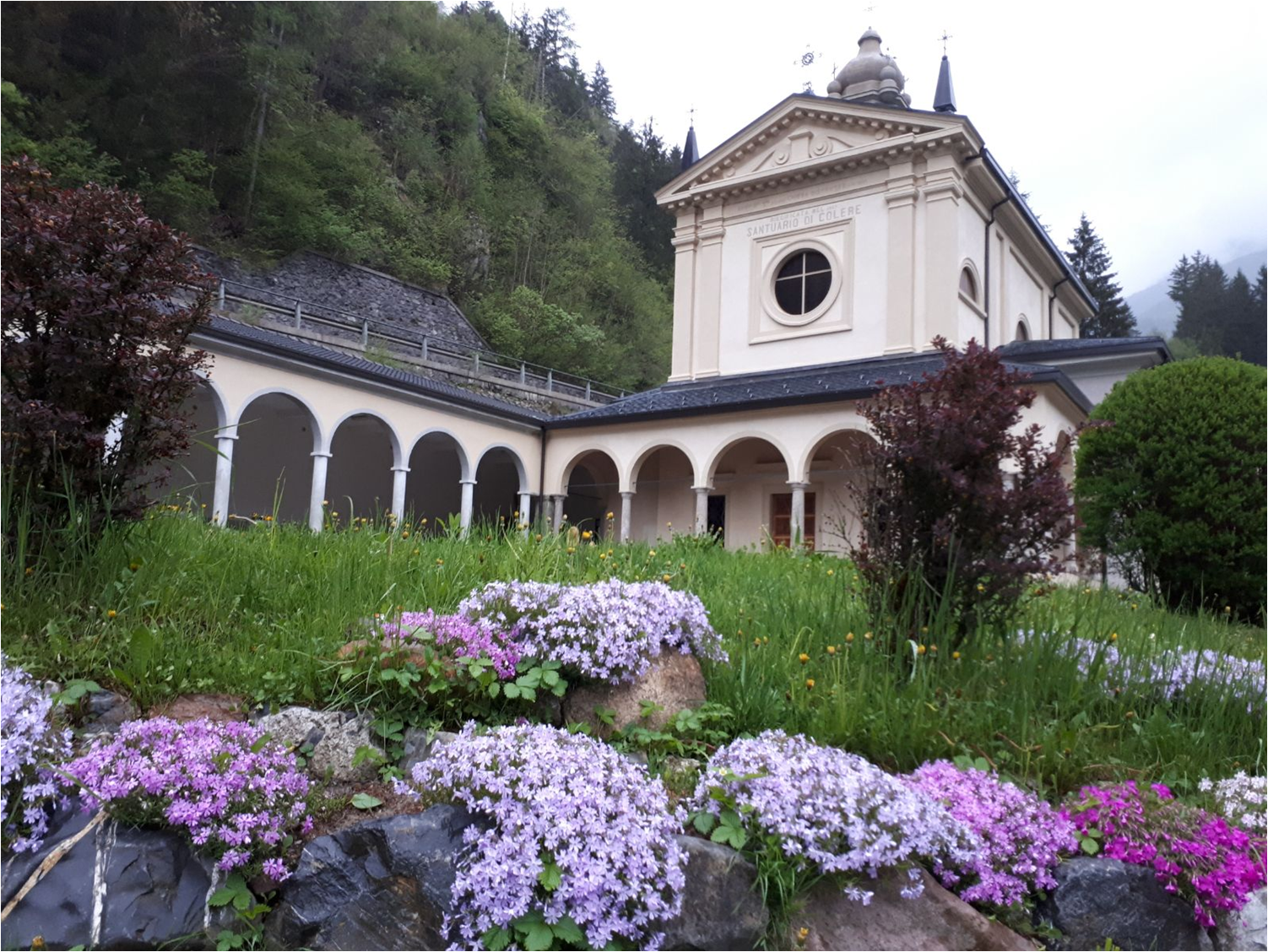
Madonnina’s Sanctuary
Located in the Dezzo di Scalve area, the Sanctuary is still today a very important place of reference for all the faithful of the valley and beyond.
The Miracle:
A poor shepherd from Borno, Bartolomeo Burat, had laboriously arrived with his flock in Val di Scalve. The poor man, suffering from tuberculosis, on the morning of July 2, 1654, had pushed himself, walking with difficulty, to Dezzo, in the Fontane area. Here there was a spring and a small 15th-century chapel dedicated to the Virgin Mary. While the sheep were drinking, the shepherd gazed at the image of the Virgin, praying and seeking strength to continue. He was struck by such a strong attack that he thought he would die. Suddenly, a majestic Lady appeared, wrapped in a bright light, who, immersing her hand in the fountain, touched Bartolomeo’s forehead and disappeared. The shepherd immediately felt perfectly healed and joyfully proclaimed the miracle.
The news of the miraculous apparition spread quickly.
Pilgrims came to the chapel from everywhere to pray and ask for favors. In a few years, devotion to the “Madonnina delle Fontane” grew, as did the alms and offerings that allowed the construction of the Sanctuary.
The Madonnina delle Fontane is also credited with having ended the terrible feud between the people of Scalve and Borno over the determination of the boundaries of their respective properties, which had lasted about 600 years. On March 15, 1682, a peace agreement was signed in front of the Madonnina chapel.
The Sanctuary:
The first written record of the Sanctuary’s construction dates back to around 1700.
In 1750 Dezzo was made an independent parish, but the parish of Colere requested and retained the Sanctuary of the Madonnina.
In 1840, the inhabitants of Colere built the main altar in marble as a sign of gratitude for having stopped the “malignant fever” that had claimed many victims during that period. On the same occasion, the people of Colere vowed to celebrate every year on July 2 the anniversary of the apparition—a tradition that continues to this day, making it the most important day of the year for the entire town.
In 1865, the Sanctuary was enlarged to accommodate the growing number of faithful, and in 1873 a house for pilgrims was built next to it.
From 1910 to 1912, the Sanctuary was decorated, furnished, and definitively arranged.
On December 1, 1923, the Sanctuary was completely swept away and destroyed by the flood caused by the sudden collapse of the Gleno Dam.
It was certainly one of the most tragic days in the history of the entire Val di Scalve, as the flood swept away everything in its path, leaving destruction and death as far as Darfo Boario Terme.
In the spring of 1927, thanks also to the great determination of the Colere population, who imposed a self-taxation to collect the necessary funds, work began to rebuild the new Sanctuary, similar to the one destroyed. The entire population participated in the construction, including women and children. On December 8, 1927, the first Mass was celebrated. In the following years, the construction was completed, with the addition of a portico, a new house for pilgrims, and the rediscovery of the ancient spring.
In 1950, the Sanctuary was enriched with a new bell tower.
In 1954, on the third centenary of the apparition, the people of Colere and all the inhabitants of the valley gifted the statue of the Blessed Virgin Mary a golden crown, which can still be admired today. Additionally, the bell tower was finally equipped with three bells.
Visitors to the Sanctuary today can drink water from the miraculous spring by descending about twenty meters toward the riverbed, where the original environment has been faithfully recreated.
How to get there
By taking provincial road no. 294 (from Boario Terme towards Schilpario) or provincial road no. 671 (from Clusone towards Passo della Presolana-Schilpario).